Nancy Vansieleghem en Volkmar Mühleis (Eds)
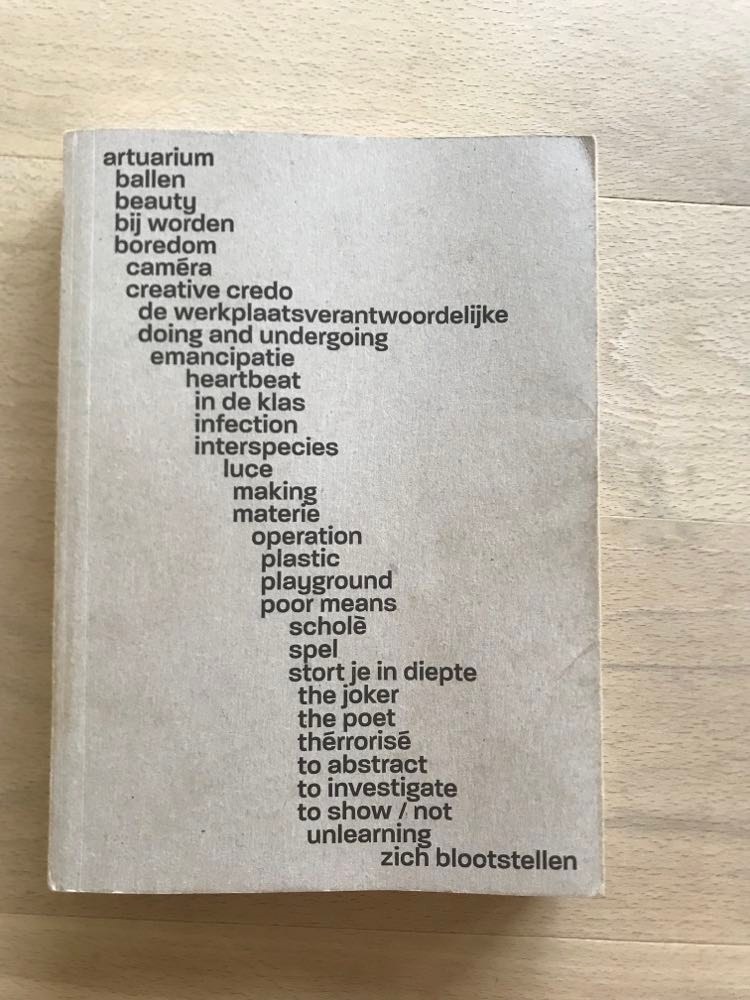
Nancy Vansieleghem, Volkmar Mühleis (Eds). (2022). Artuarium: The Grammar of Artschool. Uitgeverij Grafische Cel.
‘Art education is an education that functions more as an idea of education, as education per se, because art education is finally unspecific. But there is one characteristic of traditional art education that has remained unchanged throughout the history of art and, generally, throughout the cultural revolutions of modernity. Now, as ever before, education suspends the student in an environment that is meant to isolate him or her, to be exclusively a site of learning and analysis, of experimentation exempted from the urgencies of the outside world. Paradoxically, the goal of this isolation is precisely to prepare the students for life outside the school, for “real life”. Yet this paradox nonetheless is perhaps the most practical thing about contemporary art education. It is an education without rules. But so-called real life, where we are subject to an endless variety of improvisations, suggestions, confusions, and catastrophes, is also finally without any rules. Ultimately, teaching art means teaching life.’
p. 122-123 Uit ‘Education by Infection’ van Boris Groys
Uit de inleiding van het boek:
‘The Artuarium presents keywords to reflect on art education today. Every keyword contains a text and/or an image that has been constitutive for the formation of the art school. Some texts unfold critical ideas and questions, some images evoke careful observations, some texts tell stories, others reflect on the reflection and so on. The artuarium is a collection, not a system. It is a possible archive of a moment in time, a nucleus, network, labyrinth. You are invited to enter, to read, to bring in your experiences, and to discover statements of artists and theoreticians, as well as examples of both their practices.’
With contributions by: Giorgio Agamben, Aristoteles, Herman Asselberghs, Maïté Baillieul, Joseph Beuys, Augusto Boal, Agnes Bube, Leonardo da Vinci, Serge Daney, Marc De Blieck, Fernand Deligny, John Dewey, Ana Dimke, Mattijs Driesen, Marguerite Duras, Jerzy Grotowski, Boris Groys, Kerstin Hallmann, Lisa Jevbratt, Allan Kaprow, Paul Klee, Eva Koethen, Wiebe Koopal, Julie Lesenne, Tyson E. Lewis, Audre Lorde, Pierangelo Maset, Maurice Merleau-Ponty, Volkmar Mühleis, Ludwig Münz, Kakuzo Okakura, Jacques Rancière, Adrienne Rich, Andrea Sabisch, Ousmane Sembene, Richard Serra, Michel Serres, Friedrich Schiller, Susan Sontag, Nancy Vansieleghem, Ella Ziegler.’

 Verleiden tot het midden