We observed several hours in various workplaces to understand how art teachers assist young individuals in creating their own works of art. Based on our observation reports, we distilled a set of actions performed by the instructors. Each action was documented on a card and organized under eight themes.
We present these cards to some of the teachers and artists we observe, engaging in conversations with them to understand their values and motivations. We seek to uncover why they engage in specific actions. Why are they doing what they are doing? For each theme we spotlight one answer to offer insights into the practices of artist-teachers.
Today I speak with Lisi Estaras, a choreographer and dance coach involved in numerous dance and theater productions in Belgium and abroad. She has collaborated on various productions with Les Ballets C de la B and runs her own company: MonkeyMind Company. Lisi conducts workshops and masterclasses for diverse groups of dancers and actors in different settings. Additionally, she has conducted research on inclusive dance practices (Art Brut).
In a project at the Conservatory of Antwerp, Lisi collaborated with bachelor students in dance, working alongside dancers from Platform K and LABO; two organizations where inclusive dance practices are deeply embedded. Together with Lisi, they were developing a new performance. I had the opportunity to observe her work process multiple times and subsequently engage in a conversation with Lisi about her roles as a coach, choreographer and creator. The interview was conducted in English.
Risk and safety
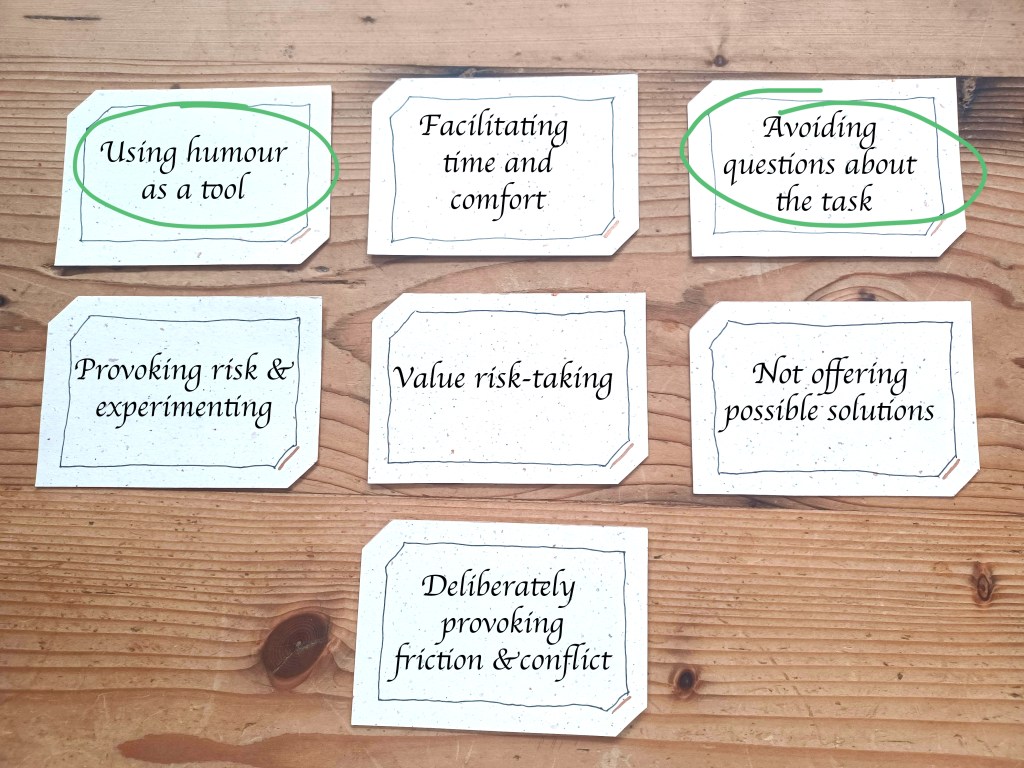
 Using humour as a tool
‘I like to laugh in the studio. I like humor in general: to not take yourself so seriously is already a piece of art. Because artists who do take themselves too seriously, I cannot cope with them. In some contexts people can be shocked by what I’m saying because it can be out of place to say it, for example in a school. They look at me and think “this is not possible”. But for me it is a way of communicating, for me it is almost like a mission to take the solemness (dignified seriousness) away from the process. I like humor. I like the absurd. I like a rehearsal being fun. For me it is very important, I want to have fun in my life. And also because I want to work in a horizontal way: if you don’t feel at ease to fantasize, if you don’t feel the freedom to propose things, it won’t be interesting. As a coach you need people to feel that they can be at ease and propose things, otherwise they will be waiting for you to tell them what to do. And that for me would be the most unartistic way of working. I don’t want that. So I put a lot of humor in the rehearsal.’
Avoiding questions about the task
‘I often say ‘I don’t know.’ Sometimes they ask me ‘Should I do it like this?” or ‘Should I come from there?”. Then I say, ‘I don’t know.’ It is a great phrase ‘I don’t know’, because then they find a solution, the solution comes from the inside. I try not to explain to much because it is contra-productive. If you know too much you kill it before you do it. ‘Nothing can go wrong. Even if you don’t understand the task, whatever you do is fine’ I say that out loud a lot’
Feedback
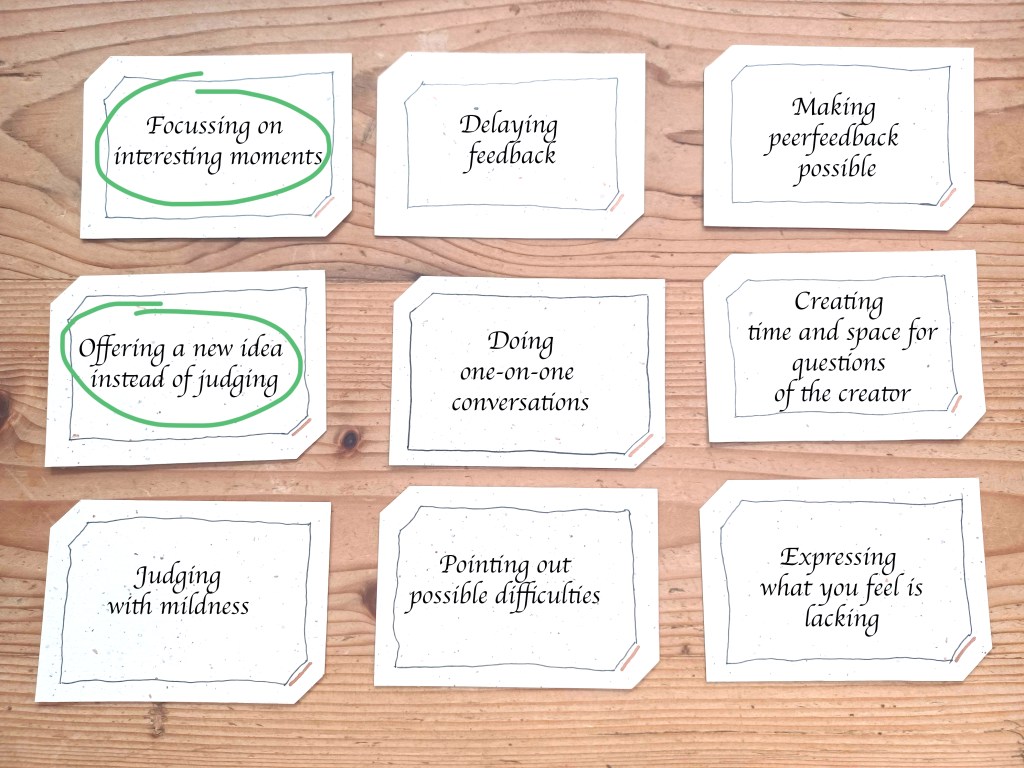
Focussing on interesting moments
‘Sometimes when I see things in a rehearsal I’m pushing them by giving positive input. And I also push them to explore. For example I ask them to speed up, to go to the end of the possibilities of something. The way I give feedback is very different depending on the process. It really depends on who I am working with and what is at stake. If the focus is on the process I will probably give examples of what I found good or strong in what they showed. That way they know what I felt and found interesting. And I also try, for each one of them, to find a good moment. I want everybody to feel good, I try to be careful that I mention something good from everyone. (…) In a conservatory many times you hear people saying things like ‘What are we going to do with these dancers, nothing is coming out of them that is interesting!’. But for me in time there will always be something interesting. You have to give it time, there is always something interesting in everyone. It is just not always showing in the first moment. With some people you connect instantly because the material connects with you. But if you don’t connect immediately and you judge too fast, you can kill it. Because in the beginning work is very fragile, they sometimes don’t even know what they are doing, and if somebody is immediately saying ‘this looks weak’, it is dead. Before you do that move as a coach or teacher, you better be very sure, because otherwise sometimes there is no way back.’
Offering a new idea instead of judging
‘I add layers. I don’t always talk about what they did, but I add something new because I like to keep going in the rehearsal or in class. I want them to get lost in the tasks by doing in action because the body collapses if you stop all the time. That’s why I always say, ‘don’t stop while I speak’. I want them to keep going in what they are doing and include what I am offering without stopping. They have to keep going. In that way even a warming-up can be creative: you are in action; you hear things and you can include them and explore them.’
Asking Questions
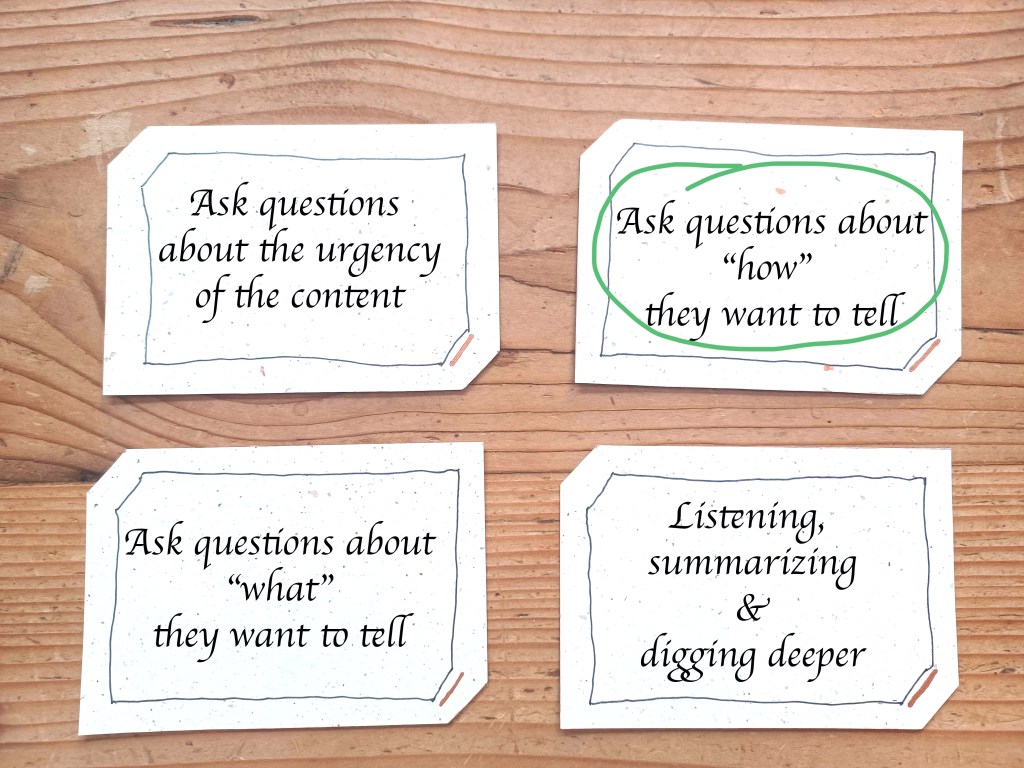
Ask questions about “how” they want to tell
‘I don’t want to know the urgency of the content; I want to see it. Asking about how they want to tell is probably more technical and has more layers for me. If you choose some kind of physicality, how is this physicality working for you? How do you want to do that? Sometimes you have a theme and then the how comes later, but sometimes you start by doing and the theme comes afterwards. It depends on if you start from the content/theme or not. (…)
With text you probably choose more in a rational way about how because of the content, but with dance it is often different. For example I am working now with a visual artist and she is using text. The words she is using, the way she is using them (the form, the structure) is saying something about the content and the emotion of it. (…)
The how and the what is always there in different graduations combined with the intuitive work.’
Assignments
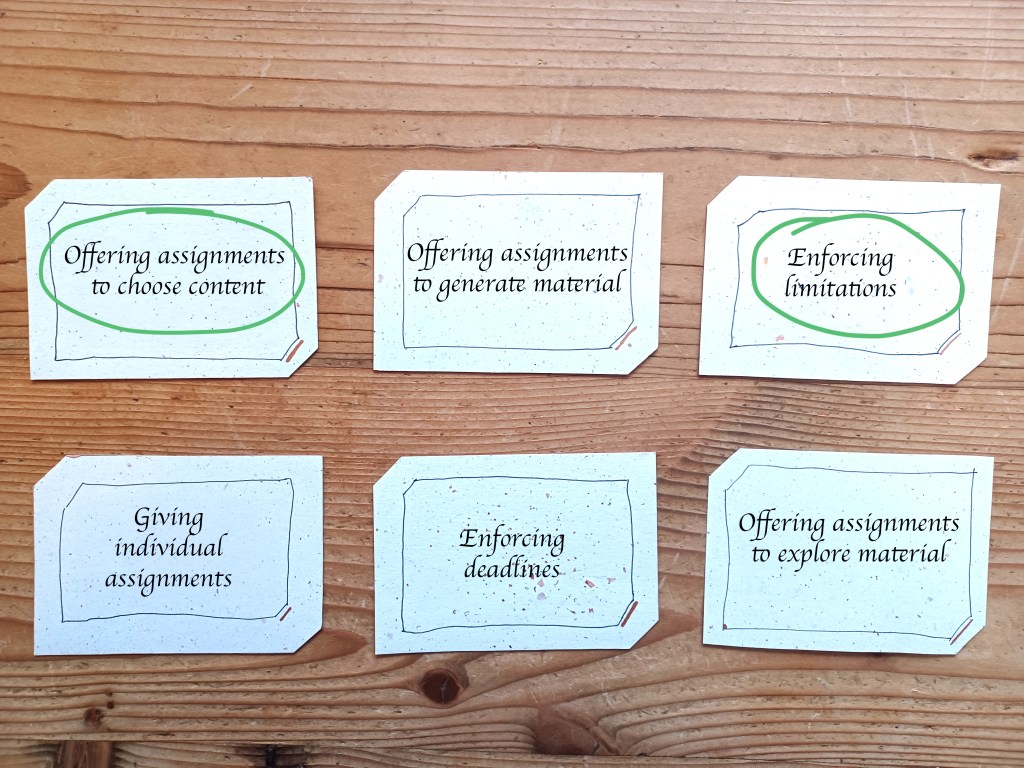
Offering assignments to choose content and enforcing limitations
‘Offering assignments to choose content and enforcing limitations often go together for me, because the assignments that I give are almost never completely free, they always have limitations. For example I am working a lot with blocking parts of the body, because it allows you to move in a different way. Of course it depends on the situation: we can choose to go deeper in what they already know or do we look for something they don’t know how to do. For me it is never about virtuosity. I want to see the person behind the technique, to see what might be wrong with that person and also that you are not like everybody else. It opens a new door. Because the first thing they normally show in a rehearsal is their skills and their qualities, what they already know and can. But for me you can find content in what is not already known, in what is not working. If you have to concentrate on how to move in a different way, in a way that is not organic, you immediately start to have a theatrical construction, a scene that might tell a story. Through the task you see the possible content. And I always try to tell stories through the physicality of the body. If you for example technically increase the speed of a movement you will come to a different state and that state might give you content.’
Being an Artist among Artists
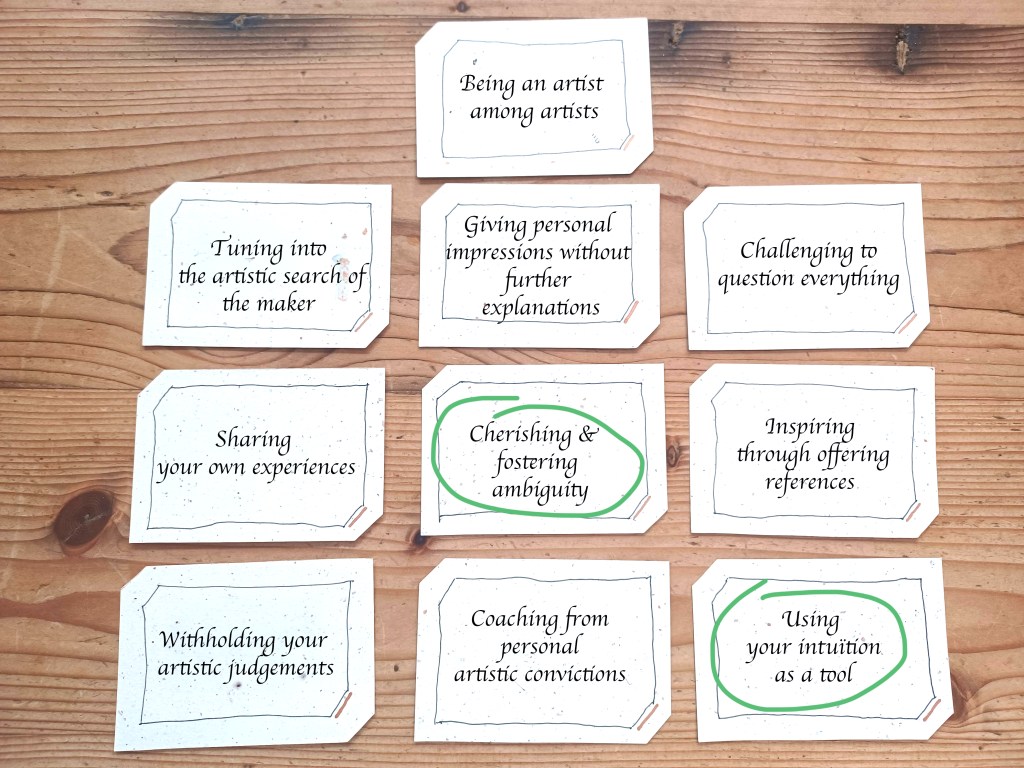
Cherishing and fostering ambiguity
‘I don’t think that I am doing it consciously. But I like to see humanity in the things I do and ambiguity for me is one of the most powerful tools we have. We have the capacity to be ambiguous. Sometimes you have to make a statement, that can be good, but not all the time, we are ambiguous in between statements. We do not take sides all the time. In theatre, in performances, I like to see this humanity. And I think if we allow ambiguity in the studio it generates material that might be ambiguous as well, which is a good thing, because it is human. (…) It also has to do with trust. Trusting the people you work with. Sometimes they tell me they want to do an 8-minute solo and I think to myself ‘that is too long’, but I say ‘OK’ and then afterwards I see that they were right, they could not explain why they needed 8 minutes, but it is good as it is, they were right. Or they do things I do not even like, but if I see that they are really believing in it, that they are defending it, it becomes very touching. So even if I don’t like it, it is great. It is beyond me liking it. Because it is about their engagement, they cannot always explain it, but you feel it is important for them. Who am I to say no? It doesn’t matter then. (…) And sometimes I like things that they do and I cannot say why, that happens as well.’
Using you intuition as a tool
‘My work is very chaotic. I go in the moment. I do prepare a lot and then I have it in my head and then I change a lot while I’m doing. In a lot of processes, for example I was working with a person with autism, I do not know what is going to happen, I have to go with the flow. We are there in the studio and we don’t know what is going to happen. It is my intuition on the spot that might see the potential on the spot and I try to go that way. (…) I share my judgements. I do not withhold them. I don’t censure myself .’
The Process
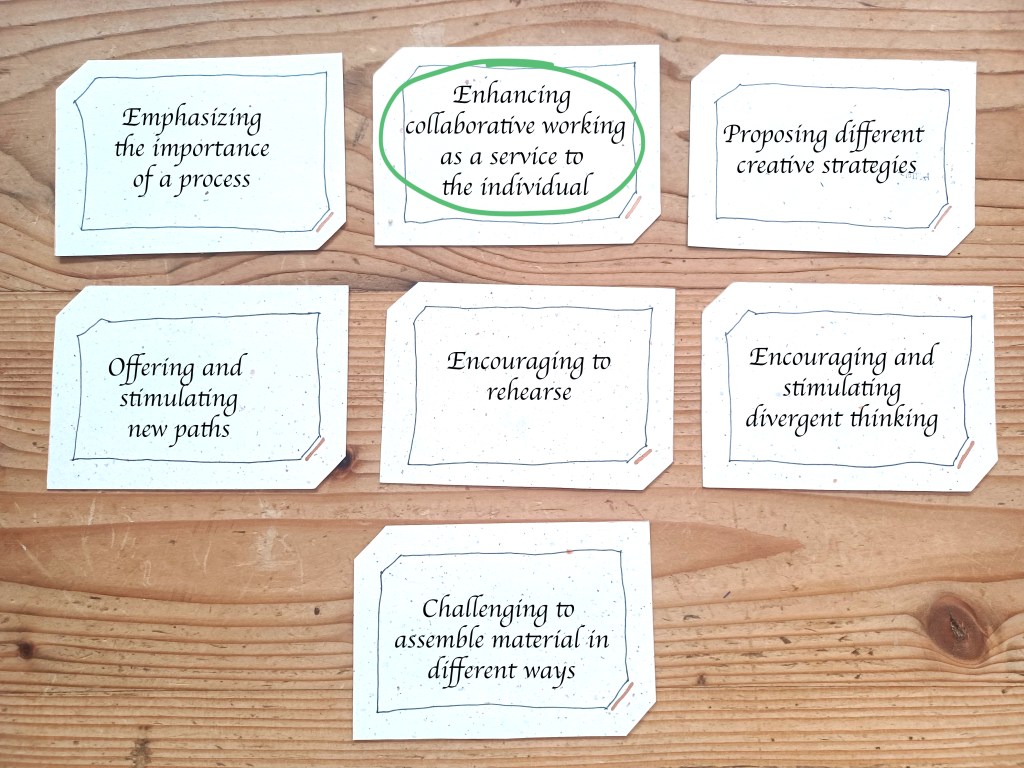
Enhancing collaborative working as a service to the individual
‘I agree with all of the cards but it is not necessarily something I talk about, because I don’t talk a lot in a rehearsal. But for example enhancing collaborative working, I do it quite a lot. Because by pushing the other you’re helping them. For me it is fundamental: when you’re in service of the other this is not passive. It is quite the opposite: you’re very active because you’re pushing the other and it is not necessarily always with kindness or about being nice. By giving contrast you’re helping the other. For me creation is not only about your own bubble, for me the world has to come inside and this is a way to be both introspective and to be connected to the outside world. I like the awareness of this, because it gives tension. In a way you function always in relation to the group. It is never a solo act even if you are solo because other people are there watching. And even if they’re not watching, they are there. That’s why it is also so interesting to work with these diverse groups because everybody in the group is very different and so it opens a lot of creative modes of doing things.’
Coaching the Individual
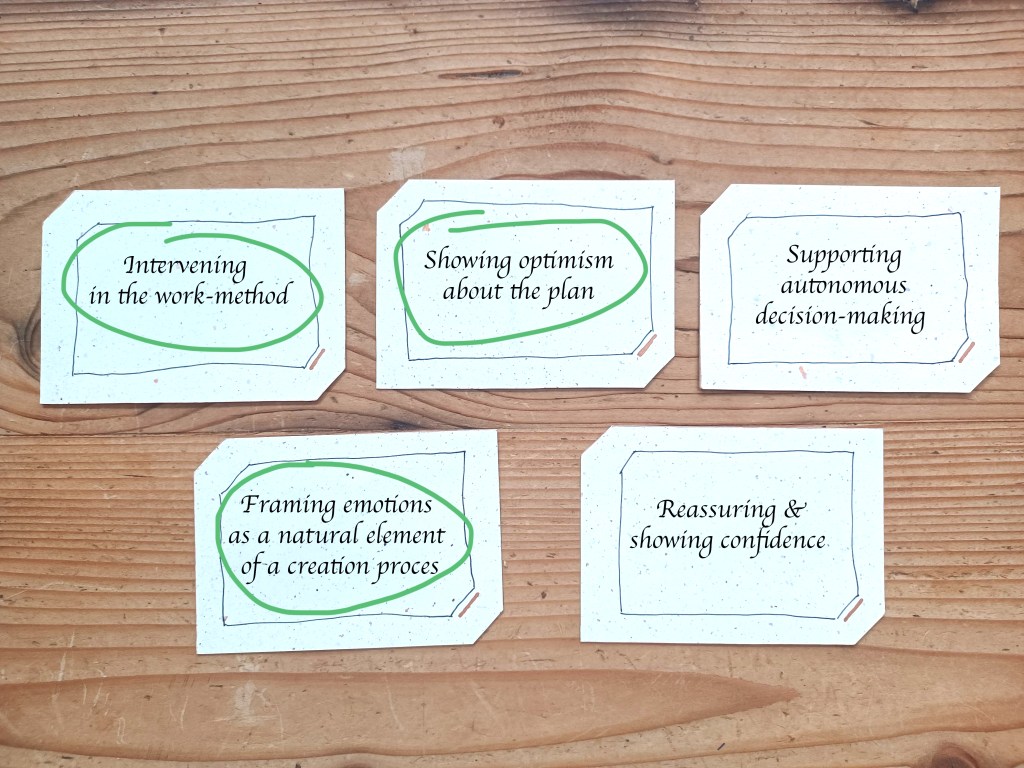
Intervening in the work-method
‘For me the work-method is really important. The way you work on things is as important as what you want to make. You have to discover your working-method. You need to have a structure for the way you want to work on something. If you have a piece, you need to dissect it and decide how you want to approach each section. You’ll need a schedule. I give an example of a partituur, how they can make sections in it, for example divide it in islands of movements where something is more fixed and the moments in between that are more free. And for these islands you can go more specific, for example they have a specific timing or a condition or this is written material or this is improvised. And in between you can keep sections free, not fix everything for example. This is especially the case with solo-work, but also with little groups. To make sure there is space for everyone. With groups you sometimes have to intervene because of the group dynamics. For example there is someone who is leading the group, the natural leader, and the others follow or they don’t connect to each other. Then you must decide if you are going to do something, are you going to act or be passive/active about it. Then you must intervene so they can give place for that person. You do a lot of negotiations to make them work together (…)
What I also do is naming material. It is really important to find a name for the material. You create a language, you create a world in the process with those words, it is your universe. You can think about the piece as your universe with these people, it cannot exist without them. You have your own codes or language which you have in common. In dance we often name things. By naming, you start acknowledging what it is, it is a mental process. We only name what we know. By naming it, it becomes something, you give it character.’
Showing optimism about the plan
‘Showing optimism about the plan is a good idea. A good atmosphere is important, the good vibe! You can only put people in a kind of tension very far in a process. When you already know the person very well and you know how you can provoke something. For example if you leave them all alone to work by themselves it can be very confronting. It can be very creative to have to make you own decisions, to be left alone and to defend what you want to do. You can be supportive by giving this freedom.’
Framing emotions as a natural element of the process
‘I don’t like so much to bring the personal life into the studio. In a way that it is not constructive for the piece. Of course we talk about things. And of course it is important that life comes into the studio but it is a very thin line how much you open up that conversation. I don’t stop a rehearsal because someone is crying, of course not. I give them time, but I don’t make a drama about it. People who have more experience are used to that, emotions happen, someone might freak out, but then we go on. I also like these emotions. I am not afraid of them. We’re always afraid when people become emotional, but we shouldn’t. It is a kind of openness that is important. If they stay they can renew themselves, because if you step out of the rehearsal because you’re emotional, you stop everything. If you take a little time and then go on and we all find it normal, you feel you are not judged because you became emotional. On the other hand I cannot cope with the diva-act: actors who tend to be very dramatic about themselves.’
Coaching the Group
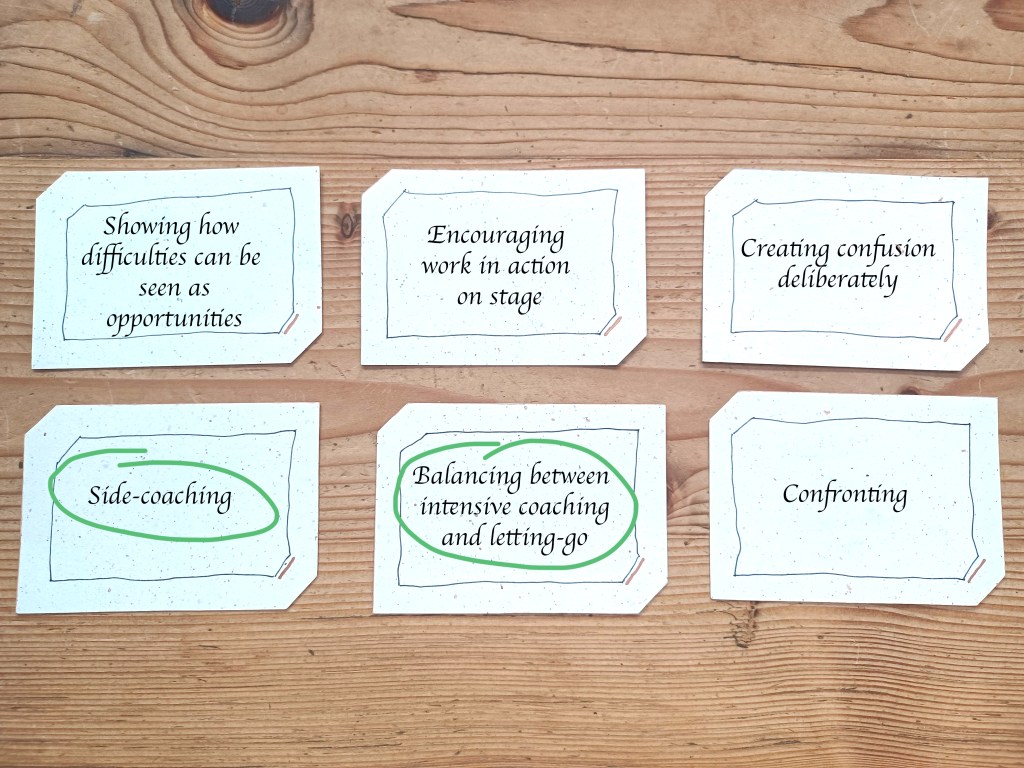
Side-coaching
‘I often start by being physical myself, for example doing the warming-up together, because when I am physical I can understand better what I need to say, I need to feel the energy myself to be able to guide, I guide with my body. And then slowly I get out to look at them and guide them further with my side-coaching. Some choreographers always stay outside and watch and coach from the side, but I like to feel it from the inside first, with my body. Many do it and some not at all. What I don’t do, because I find it horrible, is doing it how they should do it, as an example. On the other hand sometimes it is necessary to do that. Sometimes I get really irritated and then I go full force just to show them how you can move in another way. It doesn’t always have to be an organic way, sometimes (as a coach) you can cut through and shock them by doing something yourself. I also like this kind of violence, or maybe not violence, but a sort of anger. I like it on stage and I use it because it is a kind of fire or temperamental style which is also part of life.’
Balancing between intensive coaching and letting-go
‘Sometimes I do not say anything for a long time. Because I am not sure. I’m thinking about how to put it in words. Because you can kill it by saying the wrong words and then they are totally off. Or maybe not wrong, but still, it didn’t work, or you push them to a place they didn’t want. So I keep quiet. And sometimes I let things happen that are not so important, relevant or good. It is not wasting time, but it is passing time together. Sometimes they improvise and it is not going anywhere, it is useless, but you still let it be because they are having fun and they are exploring, they are chilling out. It is like having coffee but they are improvising. And then I think, ‘OK, it doesn’t matter, it doesn’t work, it is never going to work, it doesn’t have any future, but it is OK.’ I still let it be. Not because it might end up somewhere interesting, but because I think they need it. I let it be for them, because they seem to have fun. I see it is useless and it is wasting time but I let the time be wasted. Time is also there to be wasted; it doesn’t always have to be in function of something. Of course only when I have time to be wasted!’
The Missing Card
Does Lisi miss a card? What does she do when she coaches people and didn’t already see mentioned on our cards?
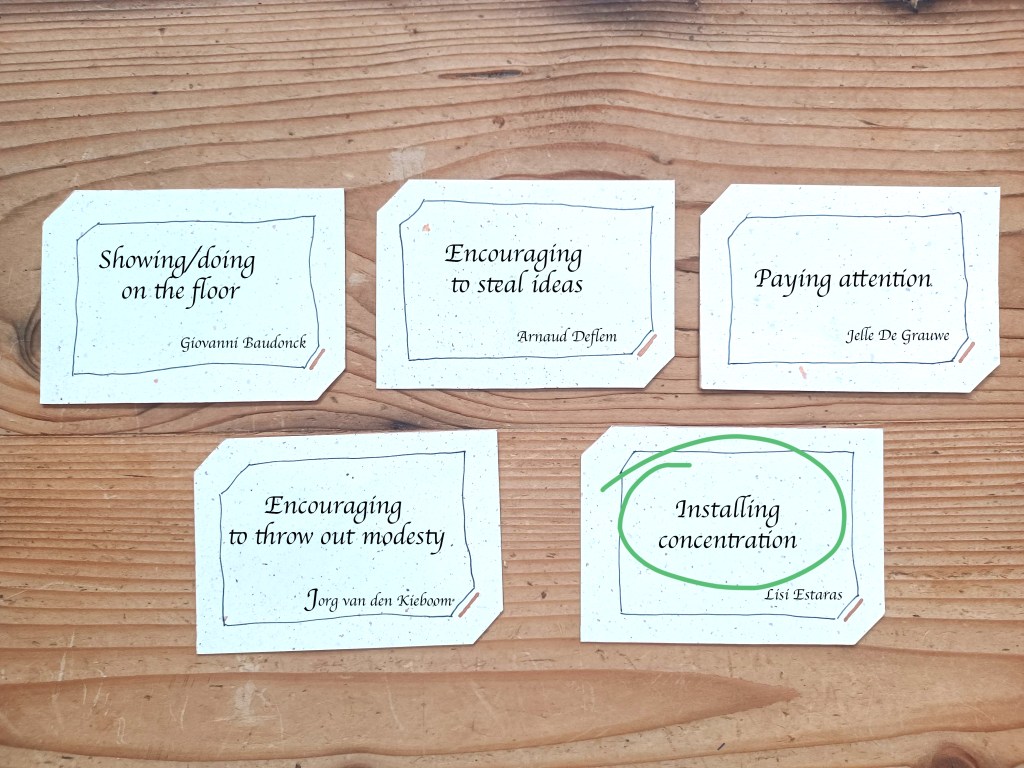
Installing concentration
‘We are so precise and creative when we are really concentrated. I have to make sure they are here and now. This contradicts with the idea that you can hear everything outside and think about everything outside. But you need both. You need to be really concentrated in the moment and be open, aware of everything outside. You are working and it is mentally and physically exhausting. I want them not to have this nonchalance-attitude. It is not about doing your thing, but about what we are constructing together. I make it so demanding that they have to be concentrated. Discipline and concentration are very important. Discipline is a very important tool. I don’t like nonchalance and being cool. Even if you’re great on stage, I don’t care. It is not interesting because it is under-estimating what the others are doing by being nonchalant. Sometimes they are like that because they are young and insecure. In that case, I don’t always say something about it, but I don’t want it in the studio. It can and should be fun and humorous, but with a conviction. It is hard work. Developing this kind of discipline for yourself is very important. I, myself, I am not nonchalant in any way, maybe by not being it myself, I might generate this attitude in the group. And it is also about having rituals or rules that are helping you to know you need to be concentrated and disciplined. I think I enforce it more in between than saying it out loud, I need them to have a kind of mentality that is concentrated and committed to do the tasks. You need your body, your head, your spirit, your love, … You need everything, you have to be devoted to do this.’

 Verleiden tot het midden